
Upcoming rounds
Schools register for a Regional Round. The strongest teams go on to a Championship Round and the Global Final.
Get updates on new rounds, registration dates and results.
Count down to
The Quadathlon Cup
A high-challenge talent-development championship built to recognise, stretch and celebrate excellence across every mind.
Academic events
A high-challenge talent-development championship where students compete in teams of four across six events. Each season is anchored to a UN Sustainable Development Goal and aligned to British international school expectations.
At a glance
Discover
Learn how the Quadathlon Cup works, how the competition is structured, and where to begin if you are new to the programme.
Plan and prepare
Move from interest to action with the competition calendar, season theme, and team event details.
The next rounds, the six events, and the theme for this season.
Schools register for a Regional Round. The strongest teams go on to a Championship Round and the Global Final.
Four individual papers and two team events. Every event tests reasoning rather than recall.
Individual events
Team events
Each season has one theme. In 2026/27 it is Life on Land (UN Sustainable Development Goal 15).
A talent-development championship where teams of four compete across six events — growth, teamwork, and academic excellence at the centre.
2026/27 season
Expand the sections below if you want more detail.
The Quadathlon Cup is designed to develop well-rounded academic thinkers. Students strengthen many kinds of reasoning through purposeful challenge and teamwork — not just the one they find easiest. Teams work best when different strengths contribute.
Core reasoning skills: Spatial, Verbal, Quantitative, and Non-Verbal.
Design thinking, 3D visualisation, transformation, and intelligent modelling.
Clarity of communication, argument precision, reading interpretation, and structured writing.
Reasoning with numbers, patterns, logic, data interpretation, and problem-solving under constraints.
Abstract reasoning, pattern recognition, classification, and flexible thinking with minimal language demand.
Competition progression: School Registration & Team Entry → Regional Round → Championship Round → Global Final (United Kingdom).
The Quadathlon Cup is designed as a clear, progressive journey. Schools begin by registering and entering teams, then progress through regional competition, advance to the championship round, and the strongest performers move on to the Global Final in the United Kingdom.
Select a stage below to view more detail.
Schools begin the Quadathlon Cup journey by registering and entering student teams. This first stage confirms participation, establishes each school’s team entry, and provides the formal starting point for progression into the competition pathway.
Years 3 to 13, in three divisions by school year. All three sit the same six events, with harder papers in each division.
Primary
Years 3–6
Grades 2–5 · typically ages 7–11
Papers written for primary pupils. The season theme supplies the contexts; every event tests reasoning rather than recall.
Lower secondary
Years 7–9
Grades 6–8 · typically ages 11–14
Harder problems in every event, with more left for students to work out on their own.
Upper secondary
Years 10–13
Grades 9–12 · typically ages 14–18
The hardest papers in each event, for upper secondary students who can work with little guidance.
Not every round runs every division. See Calendar and registration for the divisions offered at each round.
Dates and registration for every round, and this season’s theme.
Why schools participate
The Quadathlon Cup is more than a competition experience. It gives schools a structured way to challenge learners, celebrate varied strengths, and connect academic performance to meaningful real-world contexts.
The Quadathlon Cup rewards students who can transfer knowledge across domains. Instead of relying on one narrow skill, participants are challenged to think flexibly, make connections, and apply understanding in new contexts. This supports broader academic development and reflects the kind of thinking valued in high-performing schools.
Students quickly learn that strong teams are built through complementary abilities. One learner may excel in analysis, another in pattern recognition, another in communication or strategy. This makes the experience more inclusive and helps schools celebrate a wider range of academic potential.
The competition helps students see that learning is not just about getting answers right. It is also about understanding the world and responding thoughtfully to complex problems. This gives schools a meaningful way to extend academic challenge while supporting curiosity, perspective, and relevance.
Participation offers students exposure to a broader academic community and gives schools an opportunity to position themselves within an internationally minded competition pathway. It adds aspiration, prestige, and a stronger sense of purpose to student participation from the first round onwards.
Click each benefit to explore how the competition supports schools, students, and wider academic development.
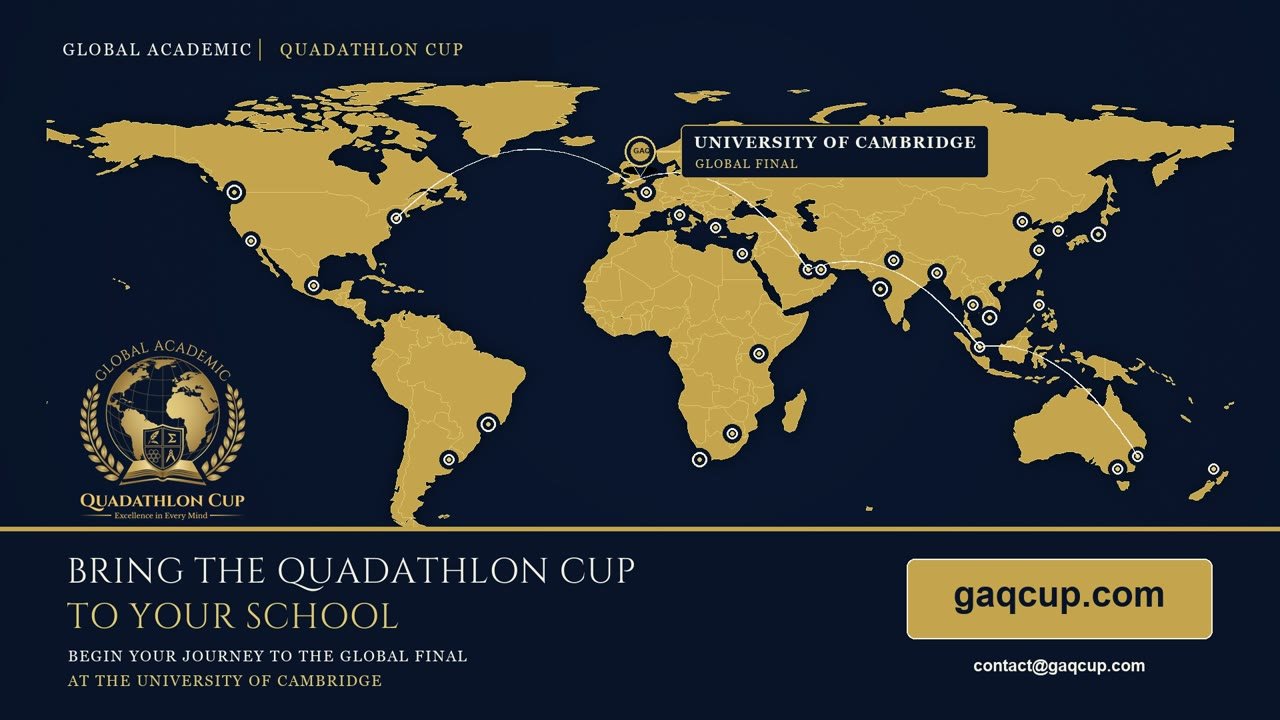
The 2026/27 season brings students to Regional Rounds across Asia, Europe and Africa, then to the Championship Rounds and the Global Final at the University of Cambridge.
2026/27 season · Now open
The Quadathlon Cup is now open for the
2026/27 season. Students in Years 3–13 compete
across six events. This year's theme is
Life on Land.
Schools can register now. Students and parents can find out more and bring
The Quadathlon Cup to their school.